
So you Want to Write a Picture Book: Things you Should Know
This article is aimed at the novice children’s book writer, however, those farther along in their study of the craft of writing kidlit will find some useful resources at the end of this post.
Purpose
Picture books are a special form of art. They can accomplish a lot of important things.
The point of picture books, as I see it, is to
help children develop a love of reading,
to expose them to the big wide world,
to help them see ways to deal with big feelings, and
to create an opportunity for kids and their caregivers to connect over a beautiful story.
Are you up to the task? No pressure.
Structure:
First things first. Here is the thing I see so many novice children’s book writers get wrong. A picture book is not merely a children’s story with pictures on each page. There is an art to writing a picture book. In this artform, words and pictures work together to tell the story. This means, without the pictures, the story isn’t complete.
If you were to only read the text of award-winning picture books (and not see the pictures), you would miss part of the story. Let’s look at an example.
This post contains affiliate links. As an Amazon affiliate, I earn a small commission on purchases made through these links at no extra cost to you. 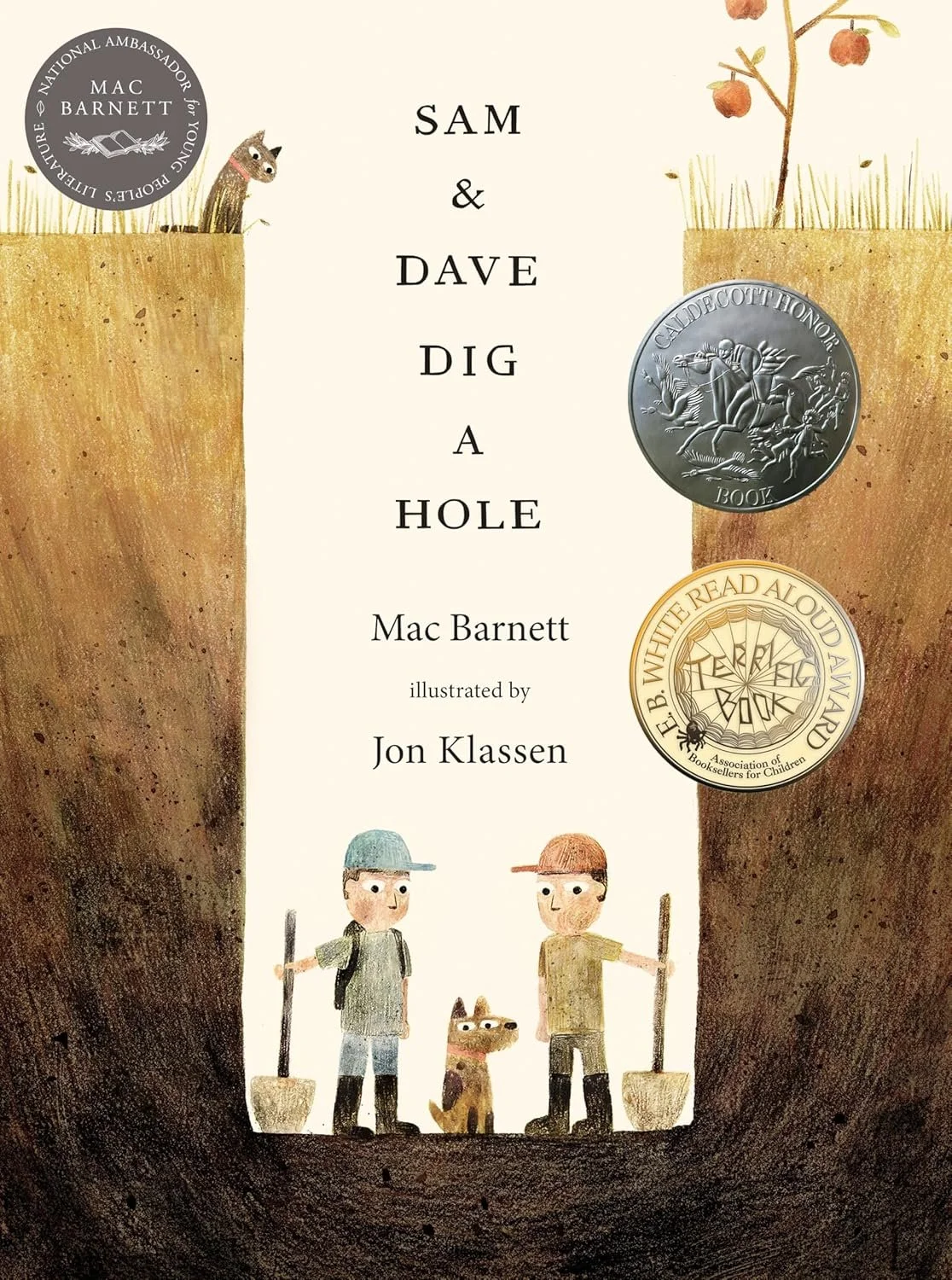
Sam and Dave Dig a Hole by Mac Barnett and Jon Klassen
The Caldecott Honor book Sam and Dave Dig a Hole by Mac Barnett and Jon Klassen is a simple story of two boys who go digging, looking for buried treasure. If you were to only read the text of the story you would probably find it quite boring (but that’s intentional). The words are quite repetitive. The boys dig, then dig some more, then stop for a break. Then they dig some more, and they keep digging, and they take another break. Nothing exciting happens in the text until the end.
The illustration tells the interesting part of the story. Look at the pictures and notice how the dog (who is never mentioned in the text) can tell where the buried treasure is. And the readers can obviously see the treasure and how Sam and Dave keep missing it. This book is a hoot! But only because the illustrations add more layers to the story. (There’s an extra twist to the story at the end, which only truly keen observers notice.)
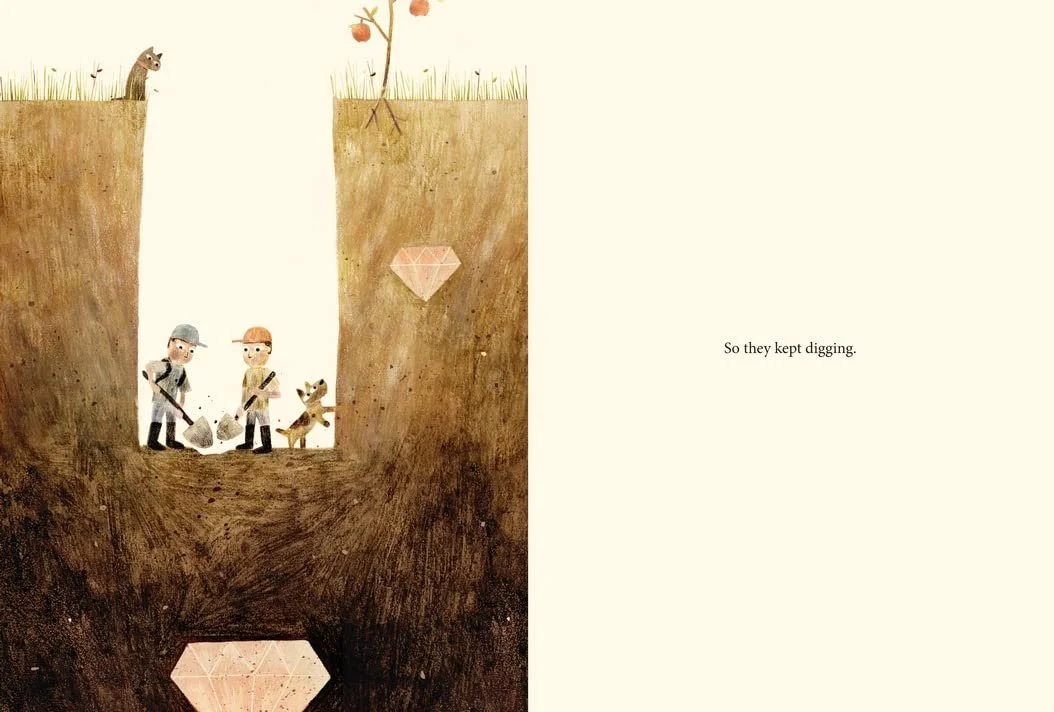
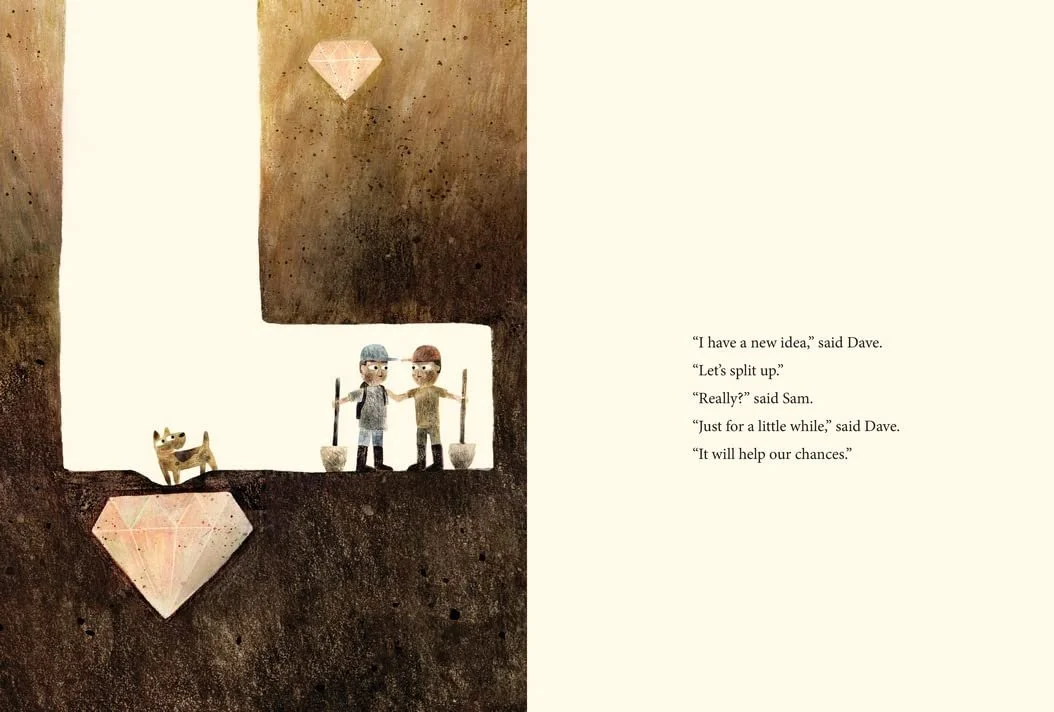
Sam and Dave Dig a Hole is perhaps an extreme example of how the illustrations of a picture book tell more of the overall story. But if you spend some time (lots of time) reading other contemporary award-winning picture books, you’ll see how the pictures don’t just repeat the information in the text; they add layers of meaning to the story.
Some other titles to study (and yes, you should be studying picture books if you’re trying to write one):
The Night Gardener by the Fan Brothers,
The Adventures of Beekle: The Unimaginary Friend by Dan Santat,
Waiting by Kevin Henkes
basically any contemporary award-winning picture book.
So what else should new picture book writers be aware of?
Besides leaving room for the illustrations to tell part of the story, keep these other guidelines in mind.
Content
Don’t be moralistic. That’s not what children find engaging in a picture book. When kids feel they are being taught a lesson, they tend to disengage. Children are fully capable of gleaning lessons from stories on their own without them being directly taught, and they are more likely to truly connect with a book and pull their own meaning from it when they are engaged in the story and can empathize with the characters.
Style
Don’t talk down to kids. Their little brains are constantly learning and making meaning of the world around them. Talk to them on their level, yes, but be wary of sounding condescending. The narrator of the story should sound like they are at the kids’ level going through this thing in life just as the target readers would. (Owl Moon by Jane Yolen is a great example of this.)
Frequently Asked Questions:
Can I use big words in a picture book? Yes, but they should be few and far between. And you must build the scaffolding into the story so kids can grasp the meaning of those big words from the context. Keep age range in mind as well. When writing for the younger ages, simpler language is better. (Remember to study books intended for the same age range for which you’re writing.)
Can I write about tough topics? Absolutely. Kids have big feelings and reading about tough things gives them a way to process those feelings. Todd Parr writes about death/loss in a sparse and quiet way in his board book The Goodbye Book.
What if I can’t draw? Do I have to find someone to illustrate my book? It depends on your publication path. Traditional publishers hire illustrators for picture book manuscripts. The author has little input in the picture-making process. Authors who plan to publish a picture book independently will need to hire an illustrator (unless you contract with a hybrid publisher who has illustrators on hand). If this is you, do your research to make sure you are hiring an actual artist and not someone using AI generated images.
How long can my picture book be? For fiction picture books, the current expectation is around 500-600 words max. Nonfiction picture books can be around 1,000 words.
Is it better to make my picture book rhyme? Only if you have studied poetry and are adept at manipulating meter. If you have no experience with anapests and the like, don’t try to write a book in rhyme until you are more educated about writing poetry. Even then, write the book without rhyming first to make sure you have a true story and not just a series of lines that rhyme.
Resources
This article only scratches the surface when it comes to what to know about writing a picture book. If you truly want to pursue this artform, you must take the time to study the craft. Join organizations, go to conferences, take a writing class, listen to podcasts, attend workshops and webinars and participate in writing/critique groups.
Here are some specific resources I trust to get you started down the path to becoming an excellent picture book writer.
I hope this article gives you a boost on your picture book writing and publishing journey. If you’d like more individualized advice, feel free to reach out through the “contact me” button at the top of this page. I’d be happy to give you more strategic guidance either through a manuscript critique/evaluation or a we can jump on a coaching call. Learn more about the specific services I offer on my Services page.
And be sure to subscribe to the Pink Pen Writerly Resources newsletter (at the bottom of this page), so you don’t miss out on future writing craft articles as well as submission opportunities. I promise not to spam your inbox.
All the best on your writing journey.
Tiffiny @The Pink Pen